
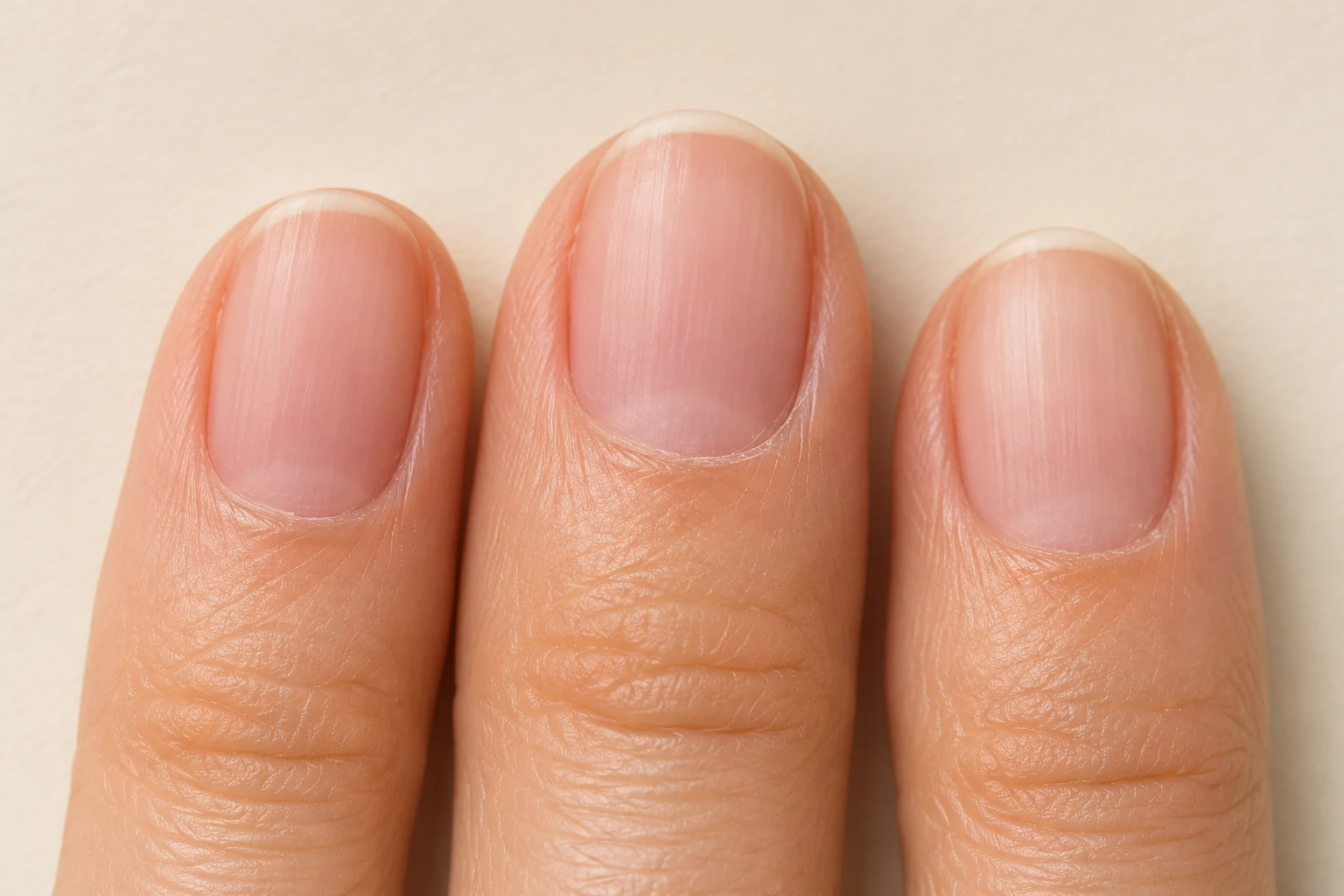
Your natural nail is the surface a press-on attaches to. Understanding a few parts makes instructions easier to follow and helps you avoid treating the surrounding skin as something to file away.
The visible nail plate, the tissue underneath it, and the skin around it have different roles. A change in one part may need a different response from a rough edge on another.
The nail plate and nail bed
The nail plate is the firm keratin structure you can see and trim. The nail bed is the tissue beneath the attached plate. They are not interchangeable names.
For sizing a press-on, focus on the visible nail surface and its side-to-side curve. A measurement described as “nail bed width” in a shopping guide may be referring to this visible surface; check the seller’s measurement method.
The matrix produces the nail plate. As new material forms, the plate moves forward. The Institute for Quality and Efficiency in Health Care explains these parts in its overview of nail structure. Structure of the nails
The cuticle and nail folds
The skin at the base and sides surrounds the nail plate. The thin cuticle at the base helps form a protective seal. In everyday conversation, “cuticle” is sometimes used broadly for the whole area, which can make preparation advice confusing.
Do not interpret “clean around the cuticle” as an instruction to cut living skin or scrape aggressively. CDC nail hygiene advice specifically says not to cut cuticles. CDC nail hygiene
The free edge
The free edge is the portion of the plate that projects beyond its attachment. It is the edge you shorten when trimming.
Your free-edge length affects how a press-on sits and how much of the underside remains accessible for cleaning. Check the set’s preparation directions, and choose a length you can manage rather than leaving extra length to support an ill-fitting tip.
Shape is more than width
Two natural nails can have the same visible width and different curves. One may be flatter across the surface; another more arched. A preformed tip needs to accommodate that shape as well as the width.
During dry fitting, look from the side and the free edge as well as from above. If a tip has to be pressed hard to flatten it, a different fit is worth considering.
What to notice between sets
Use removal time to look at the uncovered nails and surrounding skin. New pain, swelling, discharge, marked discoloration, or separation of the plate deserves attention before another application.
A photo cannot establish what caused a change. If the cause is unclear or symptoms persist, seek medical advice and keep the product names and ingredient information available.
For routine care, keep nails clean and use clean grooming tools. Leave the skin around them intact, and treat comfort as a reason to pause rather than something to push through for a manicure.