
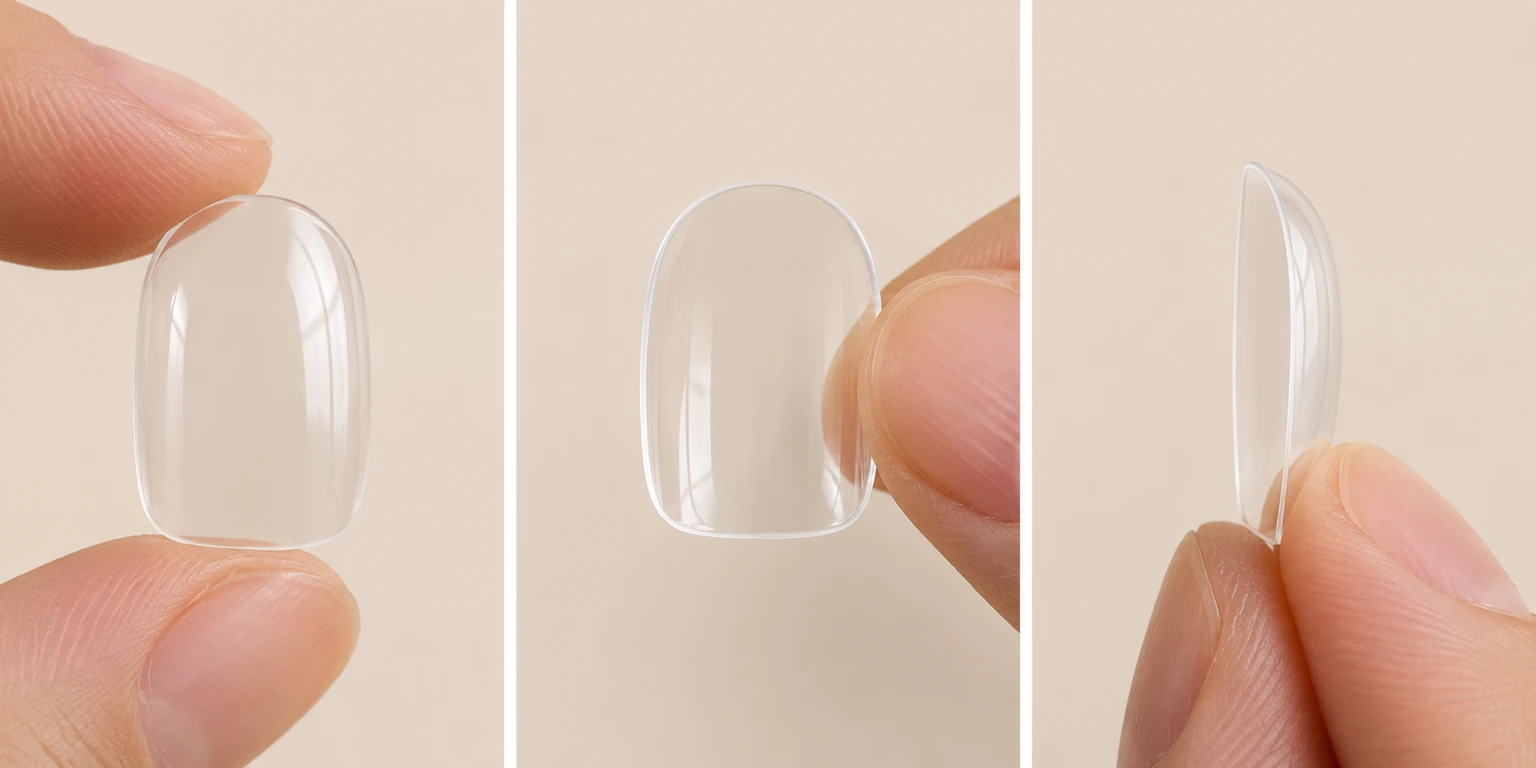
A press-on can feel bulky for several reasons: its base structure, decorative layers, length, or the way it fits. Thickness is worth examining in more than one place.
Start with an unglued tip. Looking at it from above hides much of the profile you need to assess.
Look at the cuticle edge
The edge nearest the base of your natural nail should sit neatly without overlapping skin. A visible ledge can come from the edge itself, a coating buildup, or the wrong curve.
Check whether the tip rests comfortably during dry fitting. Do not keep pressing down to make an edge appear flush if the nail feels tight.
Look from the side
A side view shows the longitudinal arch and how the body changes along its length. Compare the tip to the shape of your own nail without adhesive filling the space.
If the tip rocks or leaves a large unsupported gap, adding more glue is not a reliable substitute for choosing a better fit. Follow the product’s fit and application instructions.
Check where the decoration sits
A plain nail and a nail with a sculpted bow can have the same underlying body but different total thickness. Look at the highest decorative point as well as the edge.
Consider whether that point could interfere with gloves or catch on hair and clothing. For a first decorated set, smaller details may be easier to assess in everyday use.
Can you file a thick edge?
Only modify areas the manufacturer says can be filed. Filing can expose a different layer, change a printed design, or weaken a decorated edge.
Do not thin your natural nail to accommodate a bulky press-on. A different preformed tip is preferable to repeatedly removing natural nail material for fit.
Choose by fit, not a thickness ranking
“Thin” and “thick” are incomplete descriptions without a location and measurement. Ask where the measurement was taken and whether it includes the coating.
For comfort, dry-fit width and curve first. Then inspect the cuticle edge, front edge, and decorative height. A single side photo or thickness claim cannot replace those checks.