
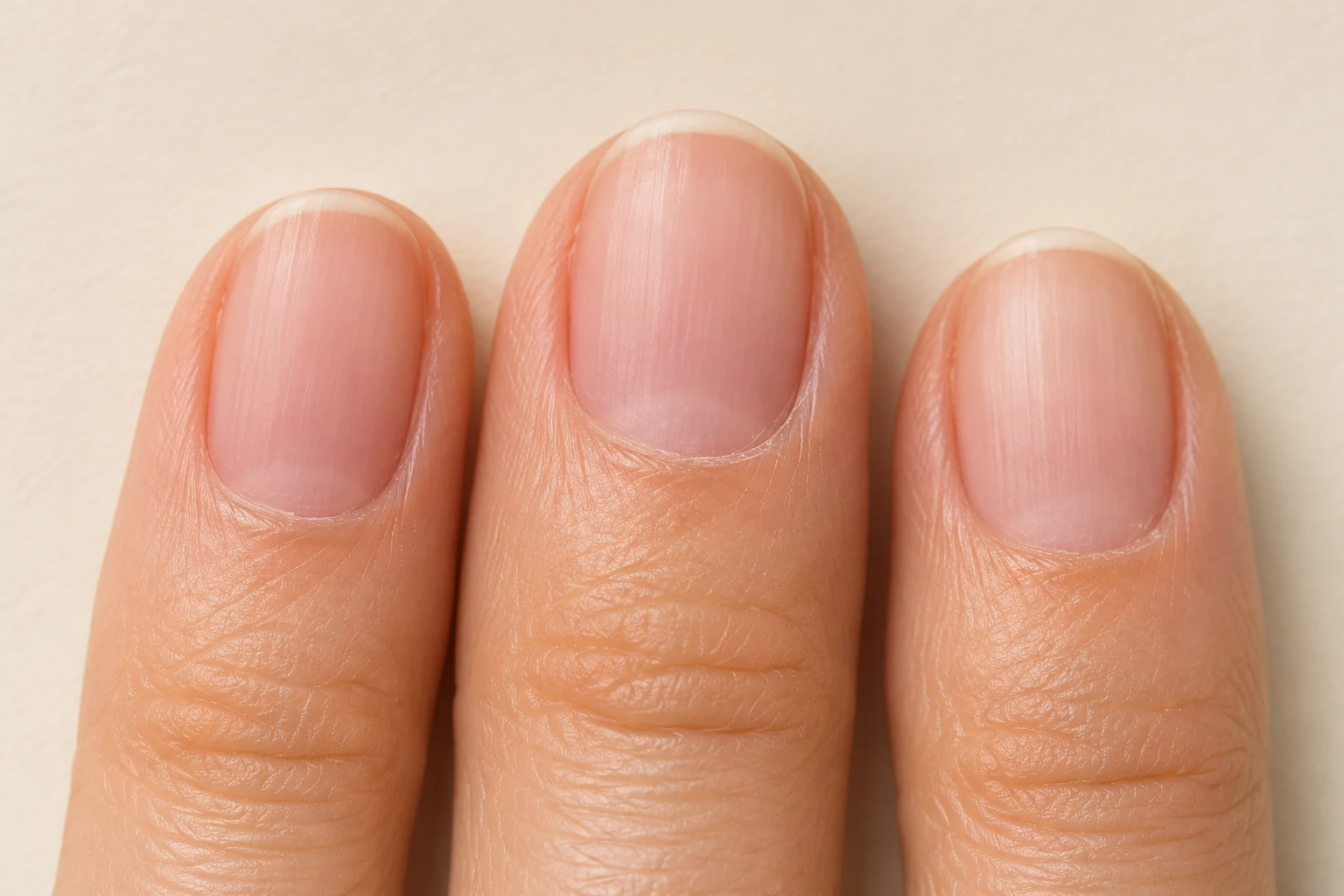
If your nails are currently painful, visibly damaged or surrounded by irritated skin, pause before applying press-ons. A cover may improve the appearance while leaving the underlying issue unresolved. Choosing a different adhesive does not automatically make that situation suitable for a manicure.
“Sensitive nails” can mean several things: discomfort after removal, a reaction to a product, naturally flexible nails or an unexplained change. Those experiences need different decisions. Describe what you notice instead of assuming one special nail set will address them all.
Start with the condition of the nail
Look for soreness, cracks, separation, unusual color or swelling around the nail. The American Academy of Dermatology warns that covering brittle, soft or damaged nails with artificial nails can worsen problems. Its guidance discusses artificial nail services broadly; it does not establish a safe press-on formula for damaged nails. Read AAD artificial-nail guidance.
If a change is unexplained or persists, ask a clinician before covering it. Avoid repeated buffing to make a thin or uneven nail ready for adhesive. NHS guidance recommends assessment for unexplained nail changes and signs of inflammation around the nail. See NHS nail-problem advice.
A gentler-sounding label is not clearance
Terms such as sensitive, gentle and hypoallergenic do not identify every possible cause of a reaction. A tab can have a different formula from a liquid glue, and either type can cause an allergic reaction. If you have a known allergy, compare complete ingredient information with the advice you have received.
FDA notes that “hypoallergenic” cosmetics have no federal definition or standard governing the term. Read FDA’s explanation of hypoallergenic claims. Do not use that word as a reason to apply a product to skin that is already reacting.
Do not perform your own allergy challenge
Trying a little glue on one finger, leaving it overnight or moving it to another patch of skin is not a reliable way to rule out allergy. A dermatologist can decide whether formal patch testing is needed and which substances to investigate. DermNet describes professional evaluation for nail-cosmetics allergy. See DermNet’s allergy overview.
Keep the adhesive, remover and preparation-product labels together. If symptoms developed after use, note the timing and take photos for your appointment. Do not apply another product simply to see whether the same reaction happens.
If you later resume press-ons
Follow any clinical advice and select a set with clear fit, preparation and removal instructions. The tip should rest comfortably without being forced down. Avoid over-filing the natural nail or adding extra adhesive to compensate for a poor fit.
Have the correct removal supplies ready and stop if discomfort develops. There is no fixed break length that guarantees readiness for everyone. Returning to nail products should depend on the condition of your nails, the reason for the earlier problem and the advice relevant to your situation.