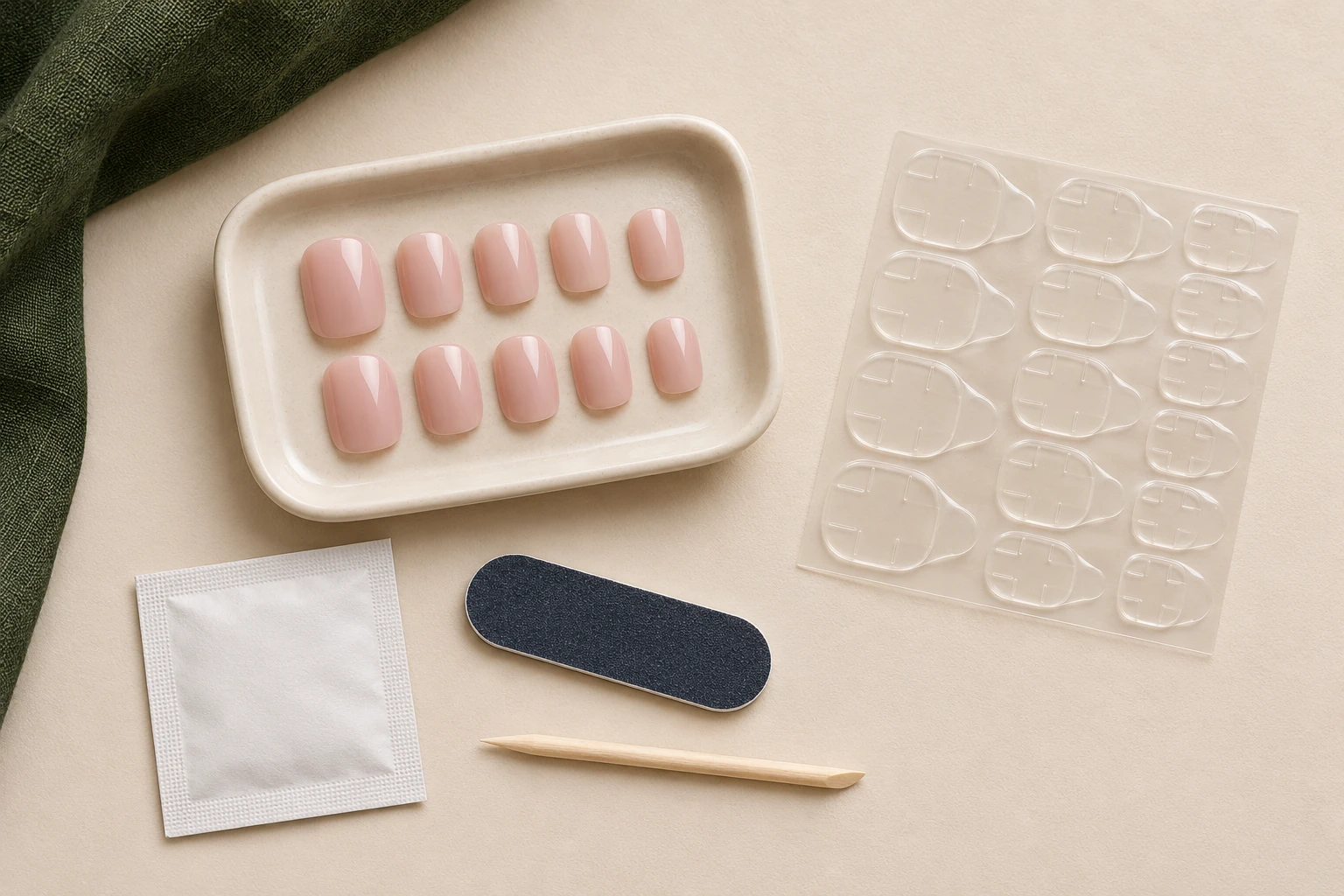
There is no blanket answer that press-on nails are safe for every child. Start with the product’s age labeling, warnings and intended use, then consider the child’s habits and activities. A small decorative nail still introduces adhesive, detachable pieces and a removal process.
If the packaging does not provide clear instructions for the child’s age, ask the supplier rather than treating the absence of a warning as approval. Products intended for adults do not become children’s products because the nails are cut shorter or applied for only a few hours.
Can the child keep products away from the mouth?
Think about nail biting, finger sucking and handling small loose objects. Detached tips and decorations can end up in the mouth. Keep all supplies and spare pieces out of reach of younger children, including during cleanup. Do not leave an open kit on a table while attending to something else.
An adult should manage any product that requires adult handling. If a child cannot reliably leave the nails alone, the occasion may be better served by another activity. Supervision helps manage behavior but does not remove the hazards listed on an adhesive or remover.
What adhesive is actually included?
Read the label rather than assuming a child-themed set uses a particular adhesive. Tabs and liquid glue have different formulas and removal instructions. Do not substitute adult nail glue or a stronger household adhesive when the original attachment seems too weak.
Fresh cyanoacrylate glue can produce a heat reaction with cotton or wool, as documented by ANSES. Read the nail-glue burn warning. Keep cotton wipes and clothing away from wet glue; do not use them to clean a spill. Store glue and remover securely in their labeled containers.
Do the nails suit the day?
Consider school rules, sports, musical instruments, outdoor play and any activity involving close contact or catching edges. A nail that presses on skin, alters grip or catches during movement is a poor fit for that activity. Do not force a narrow or strongly curved tip onto a child’s nail.
Check for nail biting damage, broken skin, soreness or an unexplained nail change before application. Avoid covering those areas. A child with an allergy history or a recurring skin problem may need advice from their healthcare professional before nail products are considered.
Can an adult remove them correctly?
Know the approved removal method before application and have its supplies ready. Do not rely on the child pulling the nails off when they become inconvenient. If a remover is required, follow its label carefully; Poison Control describes hazards from remover ingestion and eye or skin exposure. Read Poison Control’s remover guidance.
Stop use if the child reports pain, itching, burning or discomfort. For an accidental glue or remover exposure, contact US Poison Control at 1-800-222-1222; call 911 for a severe emergency. Keep the package available. A short, supervised activity still needs a clear plan for what happens if a nail loosens or the child wants it off.