
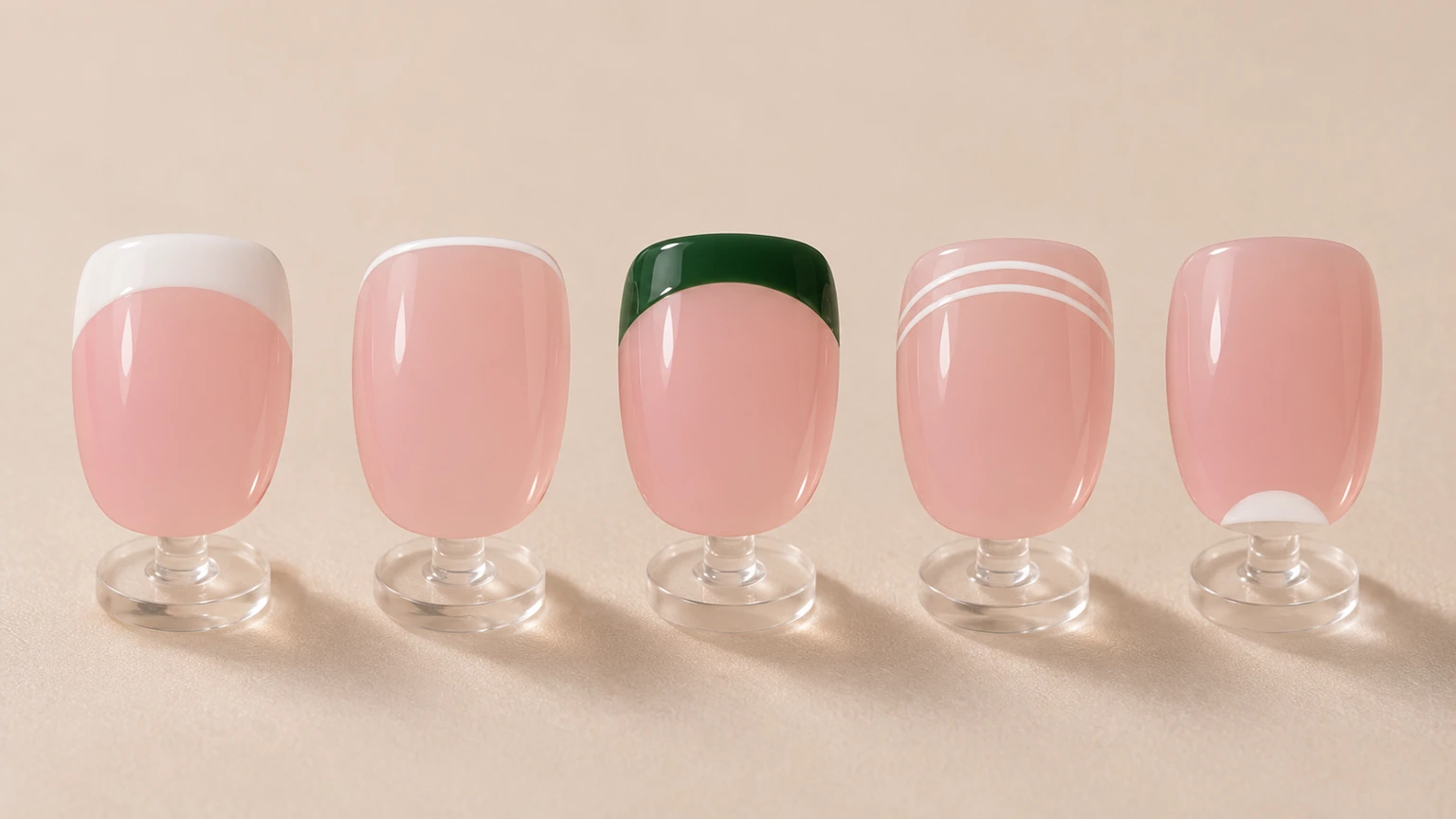
Nail style names are useful starting points, but they do not always mean the same thing across listings. Describe what you can see: the shape, colors, pattern, finish, and any raised details. Those features make a clearer design brief than a trend name on its own.
A single manicure may belong to several categories. Pink marble nails with a chrome line and a small pearl combine a pattern, a surface effect, and a decoration. Separating those features helps you understand what you are choosing.
Lines, shapes, and negative space
Geometric designs use recognizable elements such as stripes, grids, dots, blocks, or repeated angles. Their spacing and scale can matter more than the number of colors. Tiny checks have a different effect from a few broad blocks.
Negative space describes an area left visually open within a design. On a press-on, that space may be clear, translucent, or simply a color that resembles a bare nail. Look closely before assuming you will see your own nail through it. A nude painted area can imitate the effect without being transparent.
Marble, watercolor, and organic patterns
Marble-style art uses irregular veining and blended areas to suggest stone. Watercolor-style designs generally have soft, translucent-looking color boundaries. Floral, leaf, swirl, and abstract designs use more organic shapes.
These are appearance descriptions. A marble pattern does not mean a nail contains stone, and a watercolor effect does not identify the coating. When the material matters to your purchase, look for a separate material description rather than drawing a conclusion from the artwork's name.
Ombré and gradients
An ombré design blends one color or depth into another on the same nail. A gradient manicure can also refer to a progression across the hand, with each finger wearing a different solid shade. Check which version a listing shows.
For a soft blended nail, inspect where the transition starts and how much of each color remains visible. A long nail offers more room for a gradual transition. On a shorter version, the same colors may meet more abruptly or occupy different proportions.
French designs and accent nails
French styles use a contrasting tip or line as their main organizing feature. Classic white tips, thin micro tips, colored tips, and double lines all fit within that broad family. Our French design guide explains their proportions in more detail.
An accent nail has a different design from its neighbors. Ask which sizes carry that artwork if the set contains fixed designs. The prettiest decorated nail in a box is only useful on your chosen finger if the fit is right.
Read the complete set
A close-up can show a beautiful detail without showing how the manicure works across ten fingers. Look for a full layout, a worn view, and a side view where decorations rise above the surface. Check whether the listing includes the displayed assortment or lets you choose placements.
For a custom request, describe five things: shape and length, base colors, coverage, pattern placement, and surface finish. Include which details should repeat and which should appear only once. Clear priorities leave room for the artist's work while reducing misunderstandings about what the finished set is supposed to show.