
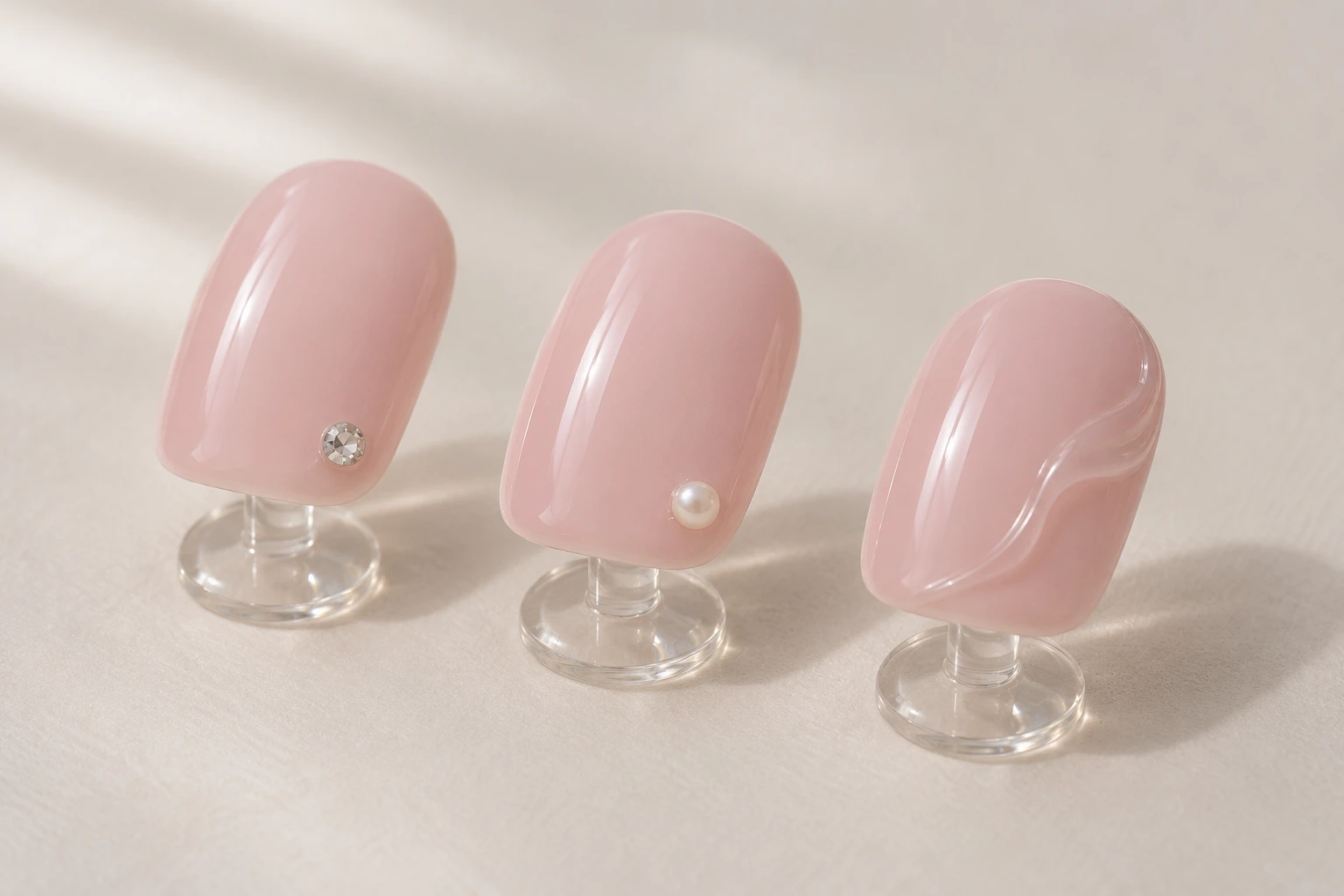
For everyday 3D nails, begin with the tasks your hands need to do. Then compare the nail's length, the decoration's height, and whether any edges project outward. A small low detail may be a more convenient starting point than a tall ornament if you are still learning what you enjoy wearing.
There is no universal everyday-safe decoration size. Your work, gloves, hobbies, and personal habits all affect which design is practical for you.
Look at height, width, and placement
A top photograph shows how much of the nail a decoration covers. A side photograph shows the height. You need both to judge a raised design. A tiny-looking bow can have prominent loops, while a wider sculpted ripple may sit close to the surface.
Check whether the detail reaches beyond the sidewall or free edge. A centered ornament with clear space around it presents a different profile from one positioned across an edge. Ask for a worn view if loose display nails make the scale unclear.
Think through a normal day
Consider getting dressed, handling pockets, washing your hair, using a keyboard, and removing contact lenses if applicable. Also consider sport, tools, or any activity where jewelry and artificial nails are restricted. Workplace or sport rules take priority over a styling preference.
If your routine involves fitted gloves, confirm the requirements for that setting before choosing artificial nails at all. Do not assume a glove makes a projecting ornament suitable for a task. For personal use, test comfort with gentle ordinary movements during dry fitting, without forcing the nail into a glove.
Keep your first set manageable
You can try one raised accent while keeping the other nails smooth. Choose a finger and placement that suit your routine, rather than automatically copying the layout in a photo. A design shown on a model's ring finger may not fit the same finger in your size assortment.
A shorter press-on can reduce the overall projection beyond your fingertip, but it does not make every decoration low. Compare length and ornament profile separately. If the nail must be shortened, check whether filing is permitted before changing a finished design.
Notice catching early
If a detail repeatedly catches hair or fabric, avoid pulling your hand free against it. Pause and release the snag gently. Repeated catching is useful information that the design may not suit the activity or needs inspection.
Do not grind, clip, or coat a decoration while it is attached to your hand to make it smoother. You may damage the attachment or create a sharper edge. If a problem cannot be resolved within the product's care instructions, remove the nail using the specified method.
Check decorations during wear
Look for a missing piece, a changed angle, a new sharp point, or movement that was not present at application. Stop using a damaged nail rather than relying on an extra dot of household glue.
Your preferred everyday design may change with experience. Keep a note of what worked: a lower profile, fewer accents, a different finger, or a shorter shape. That gives you a practical brief for the next set without assuming that more decoration must mean less comfort or that a small ornament can never cause a snag.