
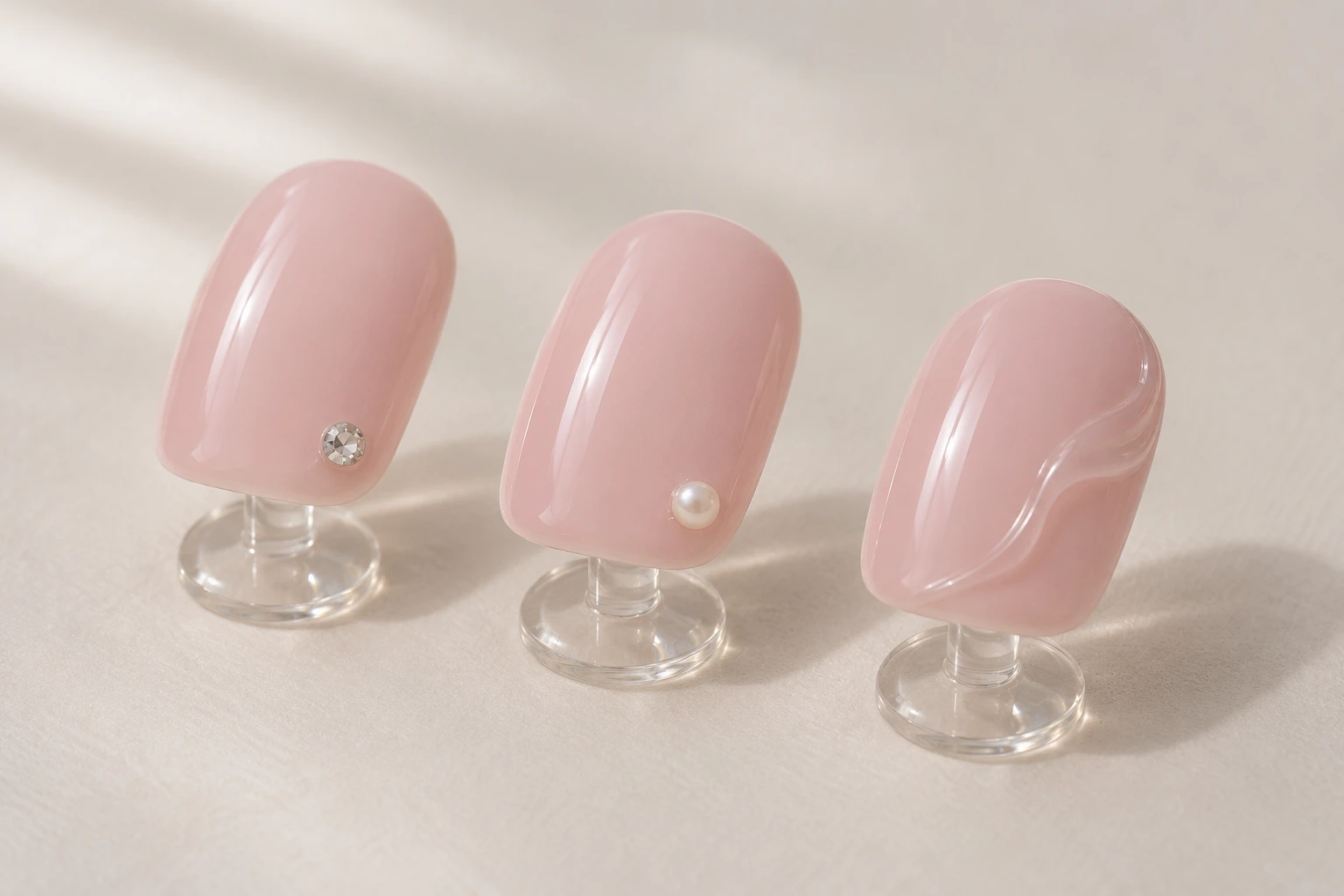
Inspect decorated press-ons before attachment and whenever a detail changes during wear. Look for cracks, a new gap, a tilted component, sharp edges, or a piece that moves during gentle ordinary handling. If something appears loose or damaged, set that nail aside instead of attaching it and hoping the adhesive underneath will solve the problem.
The adhesive holding the press-on to your natural nail and the material securing an ornament are separate parts of the finished product. Adding more of one does not reliably repair the other.
Check a new set before applying it
Place the nails on a clean, well-lit surface and compare the decorated pieces with the listing's design. Turn them slowly to see the top and sides. A low angle can reveal a lifted corner that a straight-on view misses.
Look for missing parts as well as broken ones. Check the packaging for a loose piece and keep it away from children and pets. A component resting loosely in the box should not be treated as normal simply because the remaining artwork still looks complete.
Know what a photograph cannot prove
A visible line around a gem may be part of its intended setting. A clear coating can also create reflections that look like a gap. Compare several angles before deciding that a reflection is a defect.
At the same time, a smooth appearance does not prove attachment strength. Avoid pressing, twisting, or pulling a decoration to test it. This is an inspection for observable problems, not a homemade durability test. If you remain unsure about a particular boundary, send the supplier a clear close-up and side photo.
If a piece changes during wear
A charm that rotates, rocks, or catches differently from before needs attention. Stop the activity and inspect it in good light. Do not use the decorated nail as a lever, and do not keep tugging at the piece to find out whether it will detach.
Follow the set's removal instructions if the nail is damaged or cannot be worn comfortably. A firmly attached press-on should not be pulled off because its ornament is loose. Give the removal method the time and supplies it requires.
Keep repair products separate
Household adhesive, fresh gel, and an unspecified top coat are not interchangeable repair supplies. They can change the nail's surface, create skin exposure, or require a curing process that the finished design was never intended to use.
Only make a repair if the supplier provides a suitable method for that exact product and the necessary materials can be used as directed. Otherwise, a replacement is the clearer option. Keep the damaged nail so the supplier can see the issue, but store it separately from ready-to-wear nails.
Record the useful details
For a support request, photograph the whole nail and the affected detail without heavy filters. Note whether the issue was present on arrival or appeared during ordinary wear. Describe what you observed, such as a rotating bow or a crack across the base, rather than guessing why it happened.
If surrounding skin is injured or uncomfortable, prioritize the skin and seek appropriate advice instead of covering the area again. An ornament problem should not turn into repeated handling, improvised chemical repairs, or a reason to ignore discomfort.