
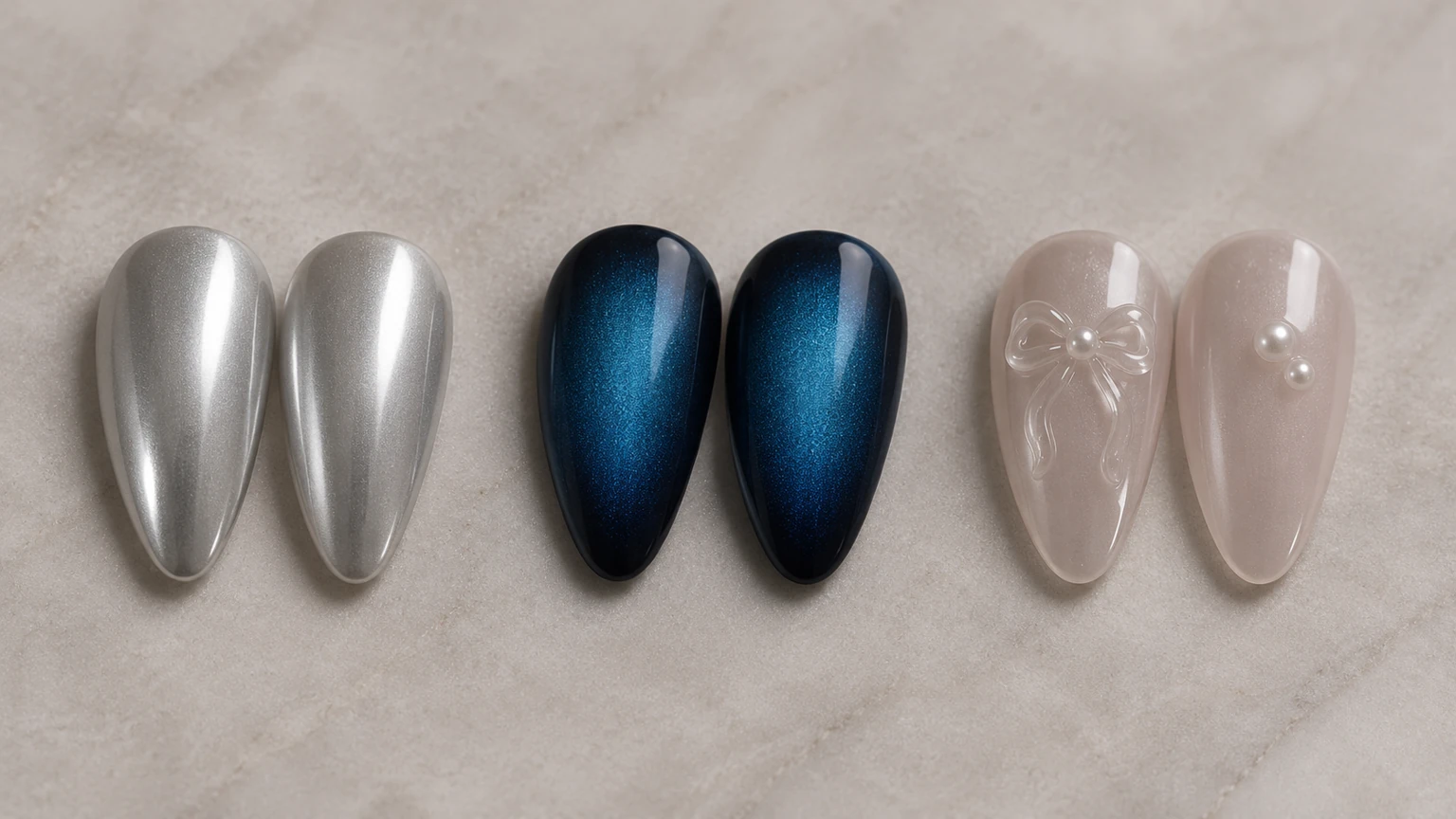
Pearls, bows, and metal charms add shape as well as color to a manicure. Before choosing, look at how far the ornament rises, where its edges sit, and how much of the nail it covers. Two designs with the same theme can feel very different during everyday tasks.
Material descriptions deserve a separate check. A pearl-like bead is not necessarily a natural pearl, a gold-colored charm is not necessarily gold, and a clear bow does not identify the polymer used to make it.
Pearl-style beads
Pearl decorations can be tiny rounded accents, half-round pieces with a flatter back, or larger beads arranged in clusters. Their apparent color may be white, cream, pink, or iridescent. Look closely at the size and placement rather than relying on the general word pearl.
For context, the FTC distinguishes imitation pearls from natural and cultured pearls in its consumer guidance. That distinction is useful when a listing makes a specific material claim; it is not a way to identify a small bead from a photo. FTC: Gemstones and pearls
Bows can have very different profiles
A printed bow sits visually within the artwork. A low sculpted bow has some height. An attached bow may have open loops, projecting tails, or a broad base. Ask for a side view if the only image is taken from directly above.
Check the outer edges as well as the center. A compact bow centered on a wide nail leaves a different amount of clear space than the same bow on a small nail. If the design is offered in several sizes, confirm that the decoration is adjusted or placed appropriately for those sizes.
Metal and metal-look charms
A silver or gold appearance describes color and reflection. It does not establish a solid precious metal, a particular alloy, or the absence of a metal you react to. If you have a known material allergy, request composition information before use rather than relying on terms such as premium or skin-friendly.
A charm can also have a coating over another material. Its care requirements belong to the complete decorated nail, including the coating and attachment, not merely to the visible metallic surface. Avoid jewelry-cleaning products unless the nail's instructions explicitly permit them.
Consider the routine around the design
Think about gloves, pockets, hair washing, knitwear, and any work that puts your fingertips in narrow spaces. A projecting loop may encounter these differently from a small smooth bead. This is a practical preference question, not a reason to assume every raised design is unsuitable for daily wear.
You may prefer to put the largest detail on one accent nail and keep the rest simple. Dry-fit the actual nails first. A decoration should not persuade you to accept a press-on that presses on skin or needs force to stay in position.
Check the finished piece
Before application, set aside nails with sharp edges, cracked ornaments, missing pieces, or details that visibly move. Do not tug at a bow or charm as a test, and do not add an unapproved adhesive around the base.
When asking a supplier about a design, include the question that matters: material, height, width, placement, or care. Specific answers will help you choose far more than a general promise that the decorations are high quality.